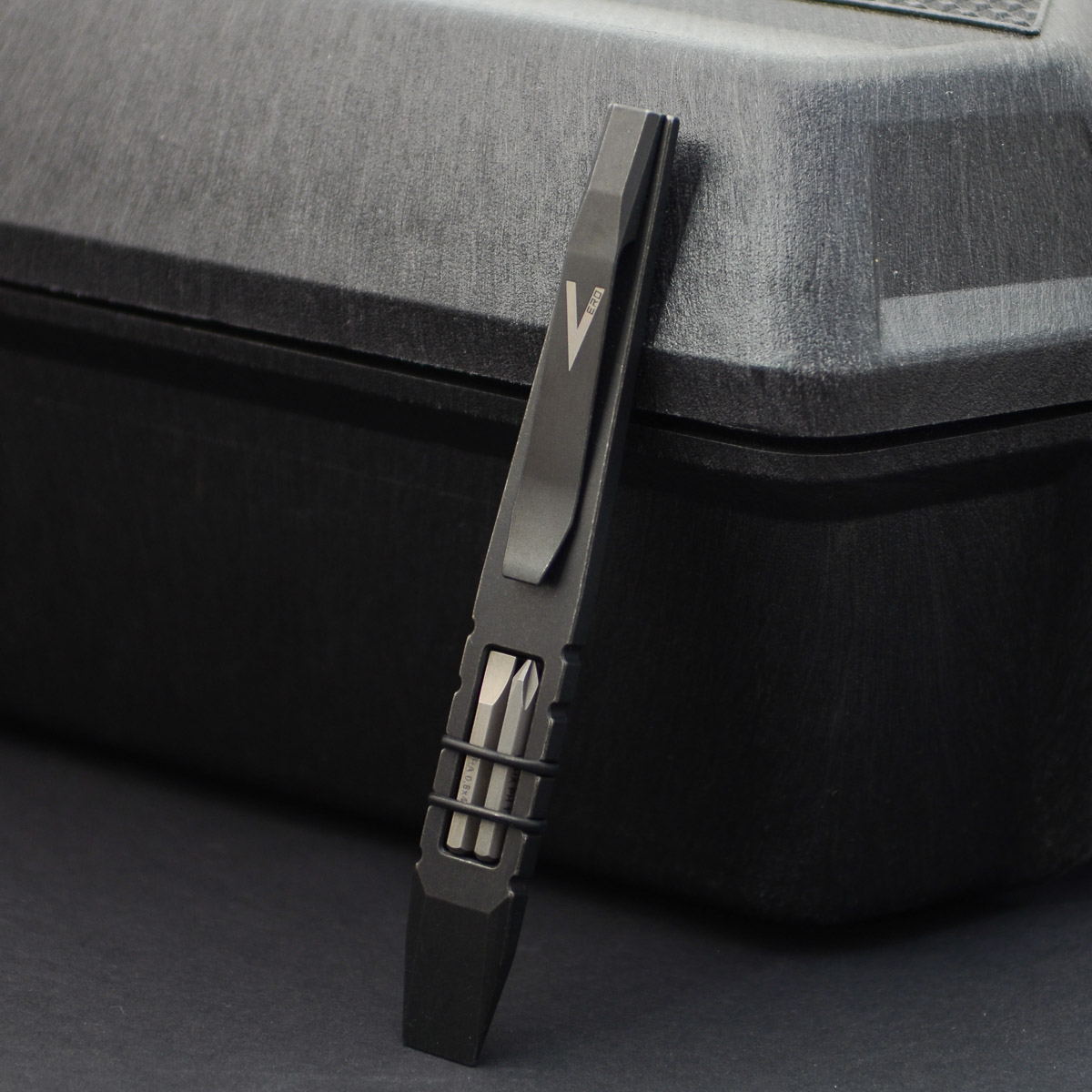
XL version of the popular Coffin Frame Lock by AUX MFG
Bowie or Tanto blade made from M390 with stonewash finish
Finely textured titanium handle scales
Reversible 3D-milled titanium pocket clip
Otter Anchor Knife Micarta Knife Lounge Exclusive
The brass anchor sits so large on the green Micarta scale that you won’t have to explain to any knife nerd what you’re holding. The Otter Anchor Knife with green Micarta and an inlay of solid brass. The trick this knife brings along: it ages right alongside you. Brass tarnishes over the years, goes darker and takes on a patina. Bolsters and pins were blasted together with the anchor and the handle scales, which leaves a matt, almost velvety feel across the whole grip.
So what is an anchor knife anyway? A classic slipjoint from Solingen, two-hand opening, with a sheepfoot blade whose edge runs almost dead straight while the spine curves generously above it. That shape is built for pull cuts, which is why it went to sea back in the day whenever hawsers and lines had to go. The anchor stood for hope, and sailors’ wives liked to send their men off with a knife like this. On land it butters a sandwich beautifully, by the way – just use the curved spine for that. The next picnic is coming.
You get a choice of steel. C75 is a non-stainless carbon steel, a keen cutter and sharp again within minutes, though it takes on a patina and won’t thank you for a damp pocket overnight. The stain-resistant blade in 1.4034 takes that worry off your hands. Anyone taking their knife onto a boat, or not wanting to dry it off every evening, picks this one.
The slipjoint spring is set good and firm, so nothing folds shut on you mid-task. Nothing locks either, and nothing opens one-handed – which is exactly why the anchor knife is § 42a compliant and may be carried in Germany.
It’s made by Otter-Messer, in Solingen since 1840 and today based on Schwertstraße. The small workshop still builds traditional Solingen knives – the Mercator and this anchor knife are the classics in the range. For you that means craft that has grown over time and has run almost unchanged for generations.
Who’s it for? Anyone who likes slipjoints and wants a knife that looks better with the years rather than worse. Harbour air is optional, but it does help the patina along!
Otter Anchor Knife Micarta Knife Lounge Exclusive
The brass anchor sits so large on the green Micarta scale that you won’t have to explain to any knife nerd what you’re holding. The Otter Anchor Knife with green Micarta and an inlay of solid brass. The trick this knife brings along: it ages right alongside you. Brass tarnishes over the years, goes darker and takes on a patina. Bolsters and pins were blasted together with the anchor and the handle scales, which leaves a matt, almost velvety feel across the whole grip.
So what is an anchor knife anyway? A classic slipjoint from Solingen, two-hand opening, with a sheepfoot blade whose edge runs almost dead straight while the spine curves generously above it. That shape is built for pull cuts, which is why it went to sea back in the day whenever hawsers and lines had to go. The anchor stood for hope, and sailors’ wives liked to send their men off with a knife like this. On land it butters a sandwich beautifully, by the way – just use the curved spine for that. The next picnic is coming.
You get a choice of steel. C75 is a non-stainless carbon steel, a keen cutter and sharp again within minutes, though it takes on a patina and won’t thank you for a damp pocket overnight. The stain-resistant blade in 1.4034 takes that worry off your hands. Anyone taking their knife onto a boat, or not wanting to dry it off every evening, picks this one.
The slipjoint spring is set good and firm, so nothing folds shut on you mid-task. Nothing locks either, and nothing opens one-handed – which is exactly why the anchor knife is § 42a compliant and may be carried in Germany.
It’s made by Otter-Messer, in Solingen since 1840 and today based on Schwertstraße. The small workshop still builds traditional Solingen knives – the Mercator and this anchor knife are the classics in the range. For you that means craft that has grown over time and has run almost unchanged for generations.
Who’s it for? Anyone who likes slipjoints and wants a knife that looks better with the years rather than worse. Harbour air is optional, but it does help the patina along!
Spyderco PITS 2
The Spyderco PITS 2 is one of those knives that makes you pause for a second and ask: “How exactly does this work?” – and that’s a big part of its appeal.
Designed by British knifemaker Mike Read and named after his forum “Pie in the Sky” (PITS), this is a non-locking folder that is anything but ordinary. Instead of a traditional backspring, the PITS 2 uses two integrated spring arms built directly into the titanium handle scales. As you open the knife, they build tension and hold the blade securely in place. It sounds technical – because it is – but in everyday use, it feels surprisingly intuitive.
Compared to the already legendary PITS 1, the concept has been significantly refined. The original was innovative, but the PITS 2 feels like a true evolution: cleaner, more precise, and mechanically more sophisticated. Less experiment, more fully realized tool.
The blade is made from Böhler M390, delivering outstanding edge retention, strong corrosion resistance, and thanks to its full flat grind, highly efficient cutting performance. The symmetrical design fits perfectly within Spyderco’s SLIPIT concept – no lock, but still safe and intuitive in use. A reversible pocket clip allows you to carry the knife exactly how you prefer.
A knife for those who don’t just want to cut – but also appreciate clever, well-executed engineering.
A front flipper always asks for a bit of trust. You put your thumb on the exposed spine, push down, and if the geometry is right the blade snaps through on its bearings like someone gave it a hand. On the Kazy it is right. That has a lot to do with who drew the thing.
Gabriel Berthélémy, born in 1990, raised in the Ain and in Lyon, today runs the workshop La Forge AGAB in Crest in the Drôme. As a kid he took apart everything he could get his hands on – putting it back together worked out far less often, which drove his father up the wall on a regular basis. He later studied architecture and mostly worked out from it that he wanted to be at the material with his hands. Volunteer bicycle wrenching and welding got him out of Lyon and into the Drôme, where he first made jewellery from found objects. Then came Flo Baroud, his master smith, and finally the coutelier David Lespect, who taught him the liner lock. The lessons turned into a friendship.
Forging, Gabriel says, is intensely sensory: the eye reads the temperature, the sound on the anvil tells you whether the hammer landed right. The forging happens in his workshop in Gigors, mostly damascus, while other blades he works cold from solid stock. What comes out at the end is almost exclusively liner lock folders, every piece a one-off, every step of the work his own. And there is a story in there too: he met Bastards Knives in 2024 at the Strasbourg show, and a year later they built his frame lock in a run of 200 pieces. It was the first time one of his knives carried a name. Octavus, after the number eight in rugby, the position Gabriel used to play.
The Kazy is the Böker Plus translation of that handwriting. The blade is Nitro-V, a stainless nitrogen steel that takes an edge back without any fuss and forgives a fair bit in daily use, here with a two-tone finish. 6,7 cm of blade at 3,2 mm thick, 16,5 cm open, 69 g on the scale: that carries all day without dragging your waistband down. The Coyote Tan G10 scales bring a warm, slightly dusty tone that works with the two-tone blade. It locks up on a liner lock and rides on a deep carry clip that drops the knife almost entirely out of sight in your pocket.
Who is it for? Anyone who wants French custom design in their everyday rotation without joining a waiting list. Otherwise you only get this close to a knife from the Crest workshop by catching the right show at the right moment.
Blade forged from a single piece (chromium-molybdenum steel X 50 CrMoV 16) Blade oil- and ice-hardened to 56±1 HRC Made in Solingen Blade is hand-honed Olive wood handle
Ever heard of Zoobie’s Old Town Tavern in Lansing, Michigan? Probably not — unless you happen to be sitting at that very bar right now. Doesn’t matter. What matters is that GiantMouse knows the place well, has for years: a wooden bar top, cold beer, the kind of dive where three drinks in you suddenly have friends for life. The Danish-American crew just named a knife after it. The ACE Zoobie.
Let’s get this out of the way first: you’re not bringing this one to a meeting. This is a knife for the workshop, the garden, the trip where something eventually needs cutting or prying open. A big frame lock folder built for load, not for the display case. Blade in Elmax, satin finish, 89 mm long, 4 mm thick — solid edge retention, plenty tough, no drama around moisture. The frame lock opens via flipper with the clean snap you’d expect from the ACE line by now.
Handles come down to preference. Full titanium, classic and pleasantly grippy at 142 g. Or black G10 scales over a titanium liner, a bit more understated and a touch lighter at 135 g in the pocket. Both versions run on the same frame, with a reversible wire clip and identical dimensions — 122 mm handle length, 211 mm open. Both are made in Maniago, Italy, the region responsible for most of Europe’s premium folders.
Bottom line: not a knife that holds back. More the kind you eventually pull out and think — right, that’s why I wanted this. In titanium or black G10, whichever suits your mood.
Ever heard of Zoobie’s Old Town Tavern in Lansing, Michigan? Probably not — unless you happen to be sitting at that very bar right now. Doesn’t matter. What matters is that GiantMouse knows the place well, has for years: a wooden bar top, cold beer, the kind of dive where three drinks in you suddenly have friends for life. The Danish-American crew just named a knife after it. The ACE Zoobie.
Let’s get this out of the way first: you’re not bringing this one to a meeting. This is a knife for the workshop, the garden, the trip where something eventually needs cutting or prying open. A big frame lock folder built for load, not for the display case. Blade in Elmax, satin finish, 89 mm long, 4 mm thick — solid edge retention, plenty tough, no drama around moisture. The frame lock opens via flipper with the clean snap you’d expect from the ACE line by now.
Handles come down to preference. Full titanium, classic and pleasantly grippy at 142 g. Or black G10 scales over a titanium liner, a bit more understated and a touch lighter at 135 g in the pocket. Both versions run on the same frame, with a reversible wire clip and identical dimensions — 122 mm handle length, 211 mm open. Both are made in Maniago, Italy, the region responsible for most of Europe’s premium folders.
Bottom line: not a knife that holds back. More the kind you eventually pull out and think — right, that’s why I wanted this. In titanium or black G10, whichever suits your mood.
Ramon Chaves Design Aluminum handle Magnacut DropPoint blade with black PVD finish Includes Fliz sheath Each knife is handcrafted at the Böker factory in Solingen and meets the highest standards of quality, craftsmanship, and design
Handle scales for the Daily Knives AK4
Made from green Canvas Micarta
Stainless steel inlay for bow drilling (fire making)
Milled-out interior cavities on both sides providing integrated storage for outdoor and survival gear
Room for matches, tinder, fishing tackle, bandages, water purification tablets, a micro compass, tweezers, a pen, and even a Victorinox Escort
Somewhere in Bali, deep in the rainforest on the way to a waterfall, a Java flying frog sits on a wet leaf and stares at Steven Kempa. Green and orange, huge eyes, completely unimpressed. That moment apparently stuck with the Vulpex designer and at some point it had to come out — the result is right here: the VK-Frok, manufactured by Reate.
Kempa, who you may already know from his other Vulpex designs like the VK-Core, crossed his signature organized lines with something new for this project: organic, rounded shapes and a deliberately chunky presence. The 6Al4V titanium handle sits solidly in your hand, and you’ll notice the total weight of 164 g both in hand and in your pocket — which is exactly the point: the Frok doesn’t want to be a lightweight. It wants to be a user, with character.
The blade: 8.1 cm of Elmax steel at 60 HRC, a modified sheepsfoot blade with a flat grind and a hefty 4.2 mm spine. The Böhler powder steel delivers the combination of edge retention and corrosion resistance you need for everyday life — packages, apples, zip ties, whatever comes up. And the sturdy tip of the sheepsfoot blade forgives the occasional rougher job.
Now for the part the Frok is rightly getting attention for: the thumbstud! The big stud made of solid copper is Kempa’s maker’s mark and, at the same time, the frog’s eye from the jungle. If that ends up being too much for you: a low-profile replacement stud is included, and the knife runs completely without studs too. Swapping is done with the included “frog feet” tool, whose shape — just like the pivot screw and counter disc — is inspired by frog feet. The theme, carried all the way through.
The frame lock engages with the precision Reate is known for. The titanium clip carries tip-up on the right side.
The VK-Frok comes in six versions — from hand rubbed with acid wash to crystallized titanium to the fully darkwashed variant.
So who is this for? Anyone looking for a premium folder with substance and a design that tells a real story instead of just illustrating a spec sheet. The frog made the jump from the jungle straight into your pocket.
Blade Finish / Handle Material:
Satin with Black DLC / Black PVD Titanium
Somewhere in Bali, deep in the rainforest on the way to a waterfall, a Java flying frog sits on a wet leaf and stares at Steven Kempa. Green and orange, huge eyes, completely unimpressed. That moment apparently stuck with the Vulpex designer and at some point it had to come out — the result is right here: the VK-Frok, manufactured by Reate.
Kempa, who you may already know from his other Vulpex designs like the VK-Core, crossed his signature organized lines with something new for this project: organic, rounded shapes and a deliberately chunky presence. The 6Al4V titanium handle sits solidly in your hand, and you’ll notice the total weight of 164 g both in hand and in your pocket — which is exactly the point: the Frok doesn’t want to be a lightweight. It wants to be a user, with character.
The blade: 8.1 cm of Elmax steel at 60 HRC, a modified sheepsfoot blade with a flat grind and a hefty 4.2 mm spine. The Böhler powder steel delivers the combination of edge retention and corrosion resistance you need for everyday life — packages, apples, zip ties, whatever comes up. And the sturdy tip of the sheepsfoot blade forgives the occasional rougher job.
Now for the part the Frok is rightly getting attention for: the thumbstud! The big stud made of solid copper is Kempa’s maker’s mark and, at the same time, the frog’s eye from the jungle. If that ends up being too much for you: a low-profile replacement stud is included, and the knife runs completely without studs too. Swapping is done with the included “frog feet” tool, whose shape — just like the pivot screw and counter disc — is inspired by frog feet. The theme, carried all the way through.
The frame lock engages with the precision Reate is known for. The titanium clip carries tip-up on the right side.
The VK-Frok comes in six versions — from hand rubbed with acid wash to crystallized titanium to the fully darkwashed variant.
So who is this for? Anyone looking for a premium folder with substance and a design that tells a real story instead of just illustrating a spec sheet. The frog made the jump from the jungle straight into your pocket.
in cooperation with WE Knife
Toni N. Tietzel design
CPM 20CV blade with hand-satin or stonewashed finish
4 carrying options, switchable with the included Hardware Kit:
Two-handed – without lock
Two-handed – with lock
One-handed – without lock
One-handed – with lock (ships in this configuration)
Imagine packing your bag in the morning without having to wonder whether the knife is even allowed where you're headed. That's exactly the question Toni Tietzel — the mind behind TNT Knives — spent years chewing on. The answer is called Slip Bang, and it comes exclusively from your Knife Lounge in Hamburg.
The trick: instead of picking the knife that happens to fit the law, you build the one knife to fit. With two Torx sizes you turn the Slip Bang in seconds from a two-handed slipjoint without any lock all the way up to a full one-handed locking folder. In between sit the stages with thumb stud or slider — you swap a few inlays and bits of hardware, tighten the screws, done. No special tools, no fuss. The Hardware Kit you need for that comes included with the Slip Bang.
Good to know: the Slip Bang ships with the thumb studs and slider already installed, meaning it opens one-handed and locks. If you want the free, two-handed slipjoint configuration without a lock instead, just remove the thumb studs and slider.
What stays constant is the part that matters most: the blade. A drop point in CPM-20CV, a steel that holds its edge for ages and doesn't fret about a bit of moisture. The grind is, as always, thin and built for cutting performance.
The handle is grade-5 titanium, the stuff you'd otherwise find in aircraft parts. Locking is handled by the newly developed TNT-Lock, and the whole thing is assembled at We Knife, the parent of Civivi, who know how to put something like this together cleanly.
And now the part that matters for us here in Germany. As a two-handed slipjoint without a lock, the Slip Bang doesn't fall under § 42a and is legal to carry — that's the configuration for everyday use over here. As shipped, thumb studs and slider are installed, so the knife opens one-handed and locks. Whether that unambiguously makes it an Einhandmesser under §42a isn't entirely clear — more on that below in the FAQ.
On Kickstarter the Slip Bang was funded with over €54,000 — three and a half times its goal — so the scene has voted pretty clearly. The blade measures around 8.4 cm, and opened up it comes to just under 19.8 cm at just under 110 g.
By default the Slip Bang comes with a stonewash finish; the satin version is limited to 150 pieces.
Included in the Hardware Kit
Thumbstud inlays (both sides)
T6 screws for the inlays
T6 screws for the thumbstuds
Cover plate (for two-handed configuration)
T10 slider screw
T10 clip screw
T10 pivot screw
Pivot barrel + D-shape pivot
Small V-spring for the slider
Frequently asked questions about the TNT Knives Slip Bang
Does it matter if you close the knife quickly, letting it slap shut?
No. A stop pin prevents the blade from striking the backspring, even when closing it quickly. The stop pin is press-fitted into the blade and runs in a circular groove machined into the scales, giving a precise stop in both the open and closed positions. As far as we know, this is also a unique feature for a slipjoint, though we can't say that with absolute certainty.
Is the Slip Bang an Einhandmesser under §42a as shipped?
As shipped, the thumb studs and slider are installed, so the knife opens one-handed and locks. Whether that unambiguously qualifies it as an Einhandmesser under §42a WaffG isn't entirely clear, since the lock on the Slip Bang is engaged separately and, as far as we know, there's no definitive ruling on this yet. If you want to be on the safe side, carry the knife in a closed container in public, or remove the thumb studs and slider for the unlocked, two-handed configuration.
Do I need extra tools to reconfigure it?
You need two Torx sizes: T6 for the inlays and thumbstud screws, T10 for the slider, clip, and pivot. Both are common sizes that most multitools with a bit set cover. The Hardware Kit you need is included with the Slip Bang.
How do I care for the CPM-20CV blade?
CPM-20CV is corrosion-resistant, but like any steel, not fully rust-proof. After contact with moisture or acid (for example when cutting fruit), just wipe the blade down and store it dry.