Civivi Vision FG Snecx Tan Design Micarta, G10 or Ultem handle Reverse Tanto blade in Nitro-V steel with Black or Satin finish or Damascus
Average rating of 5 out of 5 stars
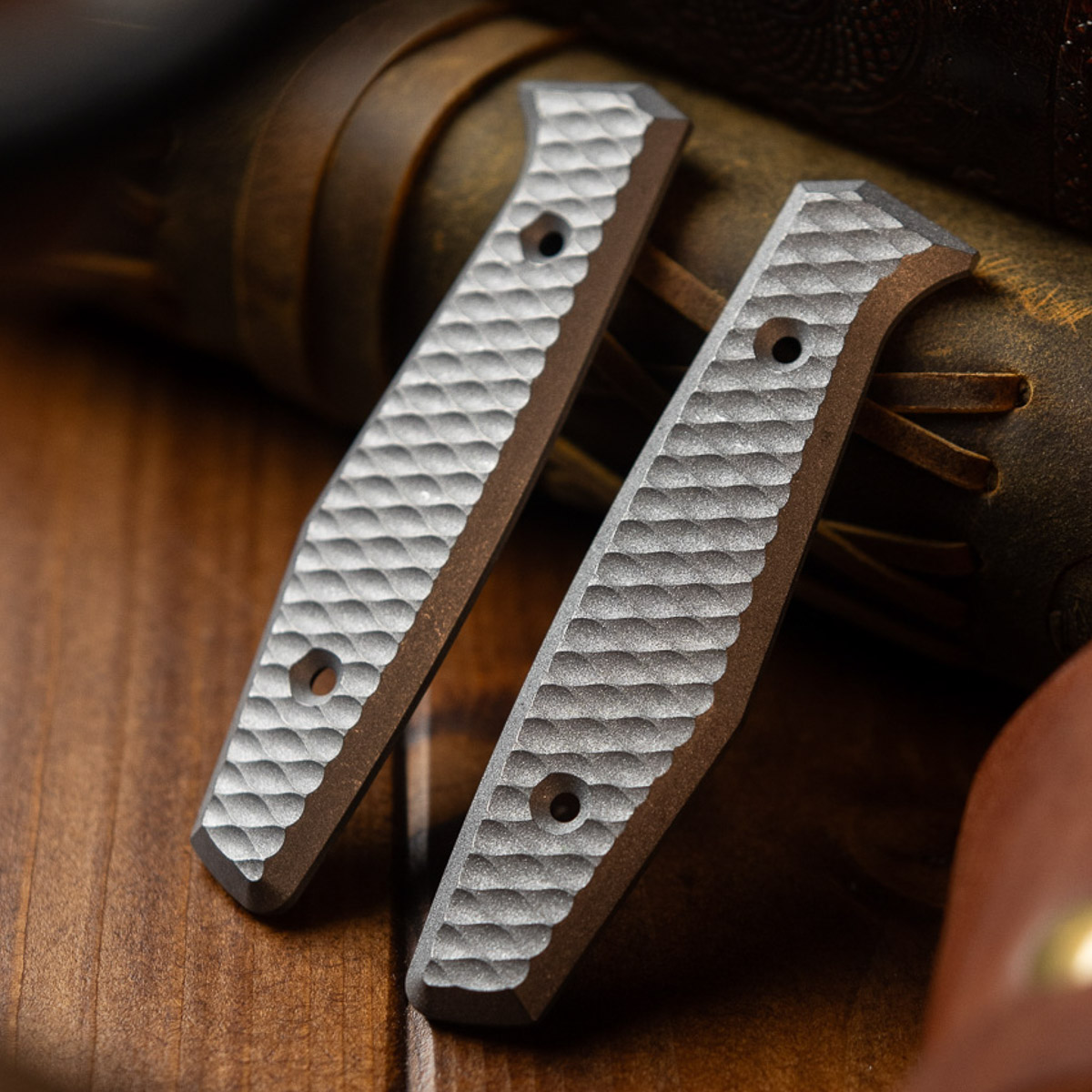
Daily Knives AK1 Scales Cross Cut Ti – Knife Lounge Exclusive Your AK1 has been sitting on your desk for weeks. The blade does exactly what it should, the sheath sits on your waistband like it was made for it, and yet every time you reach for it, there’s that quiet feeling: there’s more to get out of this. That’s exactly what these titanium scales are for, milled with our Cross Cut pattern, a precise fit for the Daily Knives AK1 and available exclusively from us at Knife Lounge. A quick bit of context in case you’re just getting into this: the AK1 is a compact fixed blade for everyday use, designed by Alex Kremer and made by Böker in Solingen. The idea behind it comes from Daily Customs. The scales are screwed on and come off with a Torx key – the knife body stays, the look changes. Once you’ve done it, you’ll see your knife with different eyes. The Cross Cut pattern is a deep cross-hatch milling that runs across the entire scale. In the light it casts small shadows, and under your thumb you feel crisp edges – which give you more grip while you work than a smooth surface would, especially when your fingers are cold or damp. Titanium also adds a bit more weight to the handle than G10 or Micarta. That makes the AK1 sit more solidly in your hand, while it’s still a knife you’ll have forgotten is on your belt after an hour. If the pattern looks familiar: we also offer the Cross Cut milling on the 91 mm scales from Daily Customs for your Victorinox. Who invented it? The Swiss. Who milled it? Hamburg. So your pocket knife and your fixed blade can head out in matching outfits. Matchy-matchy? Absolutely. But on purpose. Important when ordering: you get the scales only. Blade and screws are not included – you simply reuse the screws from your current scales. With the right Torx, the swap takes a few minutes at the kitchen table. Is it worth it? If your AK1 already lives with you and deserves a look you won’t find anywhere else: absolutely. And if you’re still wondering whether an AK1 is for you at all, you now have one more reason.
Limited to 100 pieces The “big brother” of the classic Biblio Micarta handle CPM S90V steel blade with PVD finish
Chaves Knives Redencion Street Integral Magnetic You hold the inlay up to the handle, and with a satisfying click the magnet pulls it into place. You don’t need a screwdriver for that. That’s the moment you understand why the Redencion Street Integral Magnetic gets so much attention in the scene. The knife is a folder from Chaves Knives, designed by US knifemaker Ramon Chavez. The Redencion is the model that has shaped the brand like no other, and the Street is its more compact version for everyday carry. In the Integral version, the handle is milled from a single block of titanium. Handle body and frame lock are one part – there are no screwed-on liners or spacers here. That makes the handle torsionally rigid and gives it continuous lines your eye just keeps coming back to. Pivot and clip screws are hidden, so the surface belongs to the titanium and the inlay. And you swap the magnetic inlay without any tools whenever your setup could use a different look. The blade is made from Böhler M390 and carries the compound grind that lets you spot a Chaves blade from a distance. M390 holds its edge for a long time and copes well with moisture – exactly what a knife needs when it works every day. At 8.3 cm long and around 4 mm thick, it’s strong enough for cardboard boxes and cable ties. You can get the Street as a drop point or a tanto, and the finishes range from satin and stonewash through grey and black PVD to bright DLC. It opens via the thumb studs, the blade runs on ball bearings and snaps solidly into the frame lock. Closed, the knife measures 10.8 cm, open 19.1 cm, and it weighs around 149 g. So it’s no lightweight… but hey, it’s a Chaves! If you like titanium folders, you’ll appreciate that, because this knife feels like something in your hand. The box includes the distinctive Chaves skull clip and a plain clip, depending on how much of a statement your pocket can handle.
Skandinavisches Design – direkt aus Jens Ansøs Werkstatt in Dänemark Mit dem AROS 2.0 bringt Jens Ansø ein echtes Highlight auf den Tisch – oder besser gesagt: in deine EDC-Rotation. Das kompakte Folder-Messer ist das zweite Modell aus seiner „Shop-Built“-Serie und kombiniert klares Design mit ultra-präziser Fertigung und einem Look, der ganz klar „Ansø“ schreit. Es ist außerdem der erste Button Lock, den Jens je gebaut hat – und er ist direkt ein Volltreffer geworden. Der Mechanismus läuft so unfassbar smooth, dass man ihn ständig in der Hand haben möchte. Dazu kommt ein diskreter Flipper, der beim ersten Hinsehen fast übersehen wird – aber genau da sitzt, wo er soll, und einfach funktioniert.
Interchangeable G10 scales Magnacut ClipPoint blade Made in the USA
Sebenza 31 CGG – Computer Generated Graphic: Forever Flag CPM MagnaCut blade, stonewashed, 63–64 RC 6AL4V titanium handles, glass blasted Reeve Integral Lock with Ceramic Ball Interface Made in Boise, Idaho, USA When Chris and Anne Reeve became naturalized American citizens in 2002, the American flag became their Forever Flag. It has held a place on their knives ever since — one of the most personal graphics Chris Reeve Knives has ever put on a blade. The Sebenza 31 CGG Forever Flag depicts the flag in motion: not static, not decorative, but flying — the way it has stood above people in moments that mattered. For the Reeves, it is not a political statement, but a personal one: a commitment to the country they chose as their home. The knife itself needs no introduction. The Sebenza has been the benchmark for production folders for decades. The CPM MagnaCut blade — one of the most capable production knife steels available today — is stonewashed and hardened to 63–64 RC. The 6AL4V titanium handles are glass blasted and will feel the same after twenty years of daily carry as they do on day one. The Reeve Integral Lock with Ceramic Ball Interface remains one of the most reliable locking mechanisms ever built into a production folder. The CGG finish is worked directly into the titanium scale — no sticker, no inlay print, but a process that becomes part of the knife's own surface. The result is a graphic that ages with the knife without fading. Dimensions & Weight Overall length Large: 8.40" (213.4 mm) / Small: 6.98" (177.3 mm) Weight Large: 4.7 oz (133 g) / Small: 3.0 oz (85 g) Lifetime Warranty: Chris Reeve Knives stands behind every knife for its entire service life — including a free Clean, Tune, Sharpen, and re-sandblast for unmodified knives.
Average rating of 5 out of 5 stars
Chris Reeve Knives Sebenza 31 Available in Large or SmallReeve Integral Lock with ceramic ball on the lockbarBlade steel: MagnaCutClip design: offset (on the 31, the clip now sits diagonally rather than straight) Open the blade and you notice it straight away: everything here just fits! You won’t find any bearings, yet it runs as if it’s been oiled, because the tolerances really are spot on, down to the last detail. Pick up a Sebenza for the first time and you’re guaranteed to open and close it a few more times afterwards. Just because. The Sebenza is the folder from Chris Reeve Knives in Boise, Idaho, and for many in the scene it’s the grail knife, full stop. The name comes from Zulu and means work, a nod to Chris Reeve’s South African roots. The first Sebenza was made in 1987, and since 2019 the Sebenza 31 has been the current generation and successor to the legendary Sebenza 21. The basic shape has stayed the same. The improvements are in places you’ll only notice on second glance. First and foremost, the Reeve Integral Lock, Chris Reeve’s take on the frame lock. On the 31, a ceramic ball sits in the lockbar and presses against the blade tang. Ceramic is so hard that practically nothing wears at this contact point over the years. That’s why the lock-up should feel the same after long use as it did on day one. You may already know the principle from the Umnumzaan and the Inkosi. On the 31, the clip is offset and sits at a slight angle, so it no longer presses on the lockbar. On top of that, the finger groove at the front of the handle has been reground, and you feel that straight away in the grip. The handle is made from sandblasted titanium, the hollow-ground blade from CPM MagnaCut. The steel is extremely corrosion resistant and holds its edge for a long time. For you, that means less sharpening and fewer worries when Hamburg serves up its usual drizzle. Small or Large? The Large has a 9.2 cm blade that’s 3.2 mm thick. Open, it measures 21.2 cm and tips the scales at 133 g. A full-grown work knife that still won’t hang in your pocket like a brick. The Small comes in at 7.5 cm of blade with 3.0 mm stock, measures 17.5 cm open and weighs 85 g. In the EDC world, it’s been a benchmark for years, and for good reason. Depending on availability, you can choose between a drop point and a tanto blade. Then there’s the Insingo with its long, almost straight edge, which pays off if you do a lot of draw cuts. In the end, the Sebenza 31 is a knife you don’t have to think about for long. You slip it into your pocket in the morning, it does its job, and in the evening it lies on the table just as precise as on day one. That’s really all you want from a folder.
The Fux is loose Somewhere in Potsdam, a knife designer is probably smiling to himself right now. The Reate VK-FUX is the latest folder in the VK series that Reate builds together with Vulpex Knives, and you can tell that someone spent a very long time thinking about lines. That someone is Steven Kempa, the mind behind Vulpex Knives. He started designing knives on the side, as a hobby alongside his job as a police officer, until it grew into a brand of its own. His designs are created entirely digitally in Fusion 360, and Steven likes to draw his ideas from the animal kingdom. Together with Poikilo he built the VK-Zen, which won Best Folder and Best in Show at Blade Show Texas. We’ve known Steven for years and count him among the most exciting designers in the scene. And since Vulpex goes back to the Latin vulpes, meaning fox, it’s easy to see why the name FUX makes you grin for a second. Kempa is in good hands at Reate. The VK series already includes the VK-Tron, inspired by the light cycles from TRON, along with the VK-ANUB, VK-FROK and VK-CLU. The VK-FUX joins the line-up and brings Kempa’s signature style to a format made for everyday EDC use. The blade is Böhler Elmax, hardened to 60 HRC. The powder metallurgy steel resists rust, holds its edge for a long time and still sharpens up without any drama. The drop point shape with its easily controlled tip plays to its strengths with whatever the day throws at you, from parcel tape to cord. 8.4 cm of blade at 3.4 mm thick, 19.8 cm open, 11.4 cm closed, and the whole thing weighs 105 g. The handle is titanium, and a liner lock keeps the blade open. Depending on the version, the VK-FUX comes with a darkwash finish, in frosted satin or all in black, some with a coloured anodised titanium clip. That makes it appealing to two camps: EDC folks who want a titanium folder for every day, and collectors who already keep a gap on the shelf for Kempa designs.
Legal to carry in Germany (§42a) — compliant straight from the factory, no modifications needed Lug insert instead of thumb pin — flat disc in matching gold tone, same look, different function Box Elder Burl inlay — stabilized maple burl, every piece unique Box Elder Burl is a type of maple, known for its warm, rich grain patterns. No two pieces look the same. The stabilized wood inlays on the front and back of the handle give the titanium a warmth and elegance you simply don't get with a plain Sebenza. This is the lug insert version. Instead of a thumb pin, a flat disc in the same gold tone sits where the pin would normally be. That means the knife can't be opened one-handed, making it legal to carry in Germany under §42a — straight out of the box, no retrofitting required. If you want to carry your Sebenza in public without worrying about German knife law, this is the one. Everything else stays as you'd expect: CPM MagnaCut (63-64 HRC), Reeve Integral Lock with ceramic ball interface, bronze pivot washers, offset clip. Made in Boise, Idaho. Available in Large and Small, each in Drop Point, Tanto and Insingo.
"Sebenza" means work in Zulu — and that is exactly the standard Chris Reeve Knives has upheld for over 30 years. The Sebenza 31 is not simply a new model; it is the sum of decades of experience, the tightest manufacturing tolerances in the industry, and direct feedback from a worldwide community of knife enthusiasts. With the black Canvas Micarta inlays, the Sebenza 31 takes on a character that goes well beyond the classic Plain Jane version. Micarta That Lasts Both the front and back of the sandblasted titanium handle are fitted with premium black Canvas Micarta inlays. The design on the show side was completely rethought for the 31: a single, generously curved inlay now spans the entire handle — visually clean, exceptionally tactile. Bonded to CRK's exacting standard, the inlays are built to last virtually forever. The black Micarta contrasts sharply against the matte titanium, giving the knife a focused, no-nonsense look. What matters most in daily use: the inlays noticeably improve grip security — even with gloves on. CPM MagnaCut — The Best Steel for Everyday Use The blade is crafted from CPM MagnaCut steel, hardened to 63–64 HRC. That means exceptional edge retention, outstanding toughness, and excellent corrosion resistance — a combination rarely achieved at this level. The hollow grind delivers a thin, high-performance cutting edge, while the stonewash finish minimises visible wear and adds an extra layer of corrosion protection. Ceramic Ball Interface — Built to Last a Lifetime A ceramic ball embedded in the lock bar presses against the blade tang. The extreme hardness of the ceramic reduces wear at the contact point to a negligible level — meaning the lock-up stays just as crisp and precise after years of use as it does on day one. This is the legendary "bank vault" feel that has made CRK knives famous the world over. The Details That Make the Difference The hole in the handle scale of the Sebenza 21 is gone — a long-standing wish of the Reeve community, finally answered. The pocket clip now sits at a slight diagonal and no longer presses against the lock bar. The reworked thumb ramp on the front scale provides an even more natural hand position. Small refinements, significant impact in everyday carry. Large or Small — The Right Fit for Everyone The Large Sebenza 31 (blade length 3.6", weight 4.7 oz) is a fully capable working knife that makes no compromises. The Small Sebenza 31 (blade length 2.99", weight 3.0 oz) remains the king of EDC pocket knives — compact enough for any pocket, capable enough for any task. Made in Boise, Idaho — USA Every Sebenza is handcrafted at the Chris Reeve Knives facility in Boise, Idaho. Not a marketing claim — a living tradition since 1984.
Legal to carry in Germany (§42a) — compliant straight from the factory, and your CRK lifetime warranty stays intact Lug insert instead of thumb pin — flat disc in matching blue tone, same look, different function Plain Jane — the Sebenza 31 in its purest form This is the lug insert version. Instead of a thumb pin, a flat disc in the same blue tone sits where the pin would normally be. That means the knife can't be opened one-handed, making it legal to carry in Germany under §42a — straight out of the box, without voiding your CRK lifetime warranty. Everything else stays as you'd expect: CPM MagnaCut (63-64 HRC), Reeve Integral Lock with ceramic ball interface, bronze pivot washers, offset clip. Made in Boise, Idaho. Available in Large and Small, each in Drop Point, Tanto and Insingo.
- Understated pocket knife in neo-Japanese style- Designed by Guy Poggetti- Micarta handle- Tanto blade in 14C28N steel with stonewash finish- Supplied in a high-quality nylon pouch Neo-Japan The Mini Sanjo is the more compact version of the Böker Plus Sanjo. It was designed by French knife designer Guy Poggetti, who brings Japanese design language together with modern folder technology. The style is called neo-Japan: clean, almost graphic lines without any frills. The name refers to the city of Sanjo in Niigata Prefecture, known for its long tradition of craftsmanship. From there to the Elbe it’s almost nine thousand kilometres, but the Mini Sanjo works just as well here as it does there. The blade is made from 14C28N, a stainless steel that holds its edge well and is easy to resharpen. Its shape borrows a fair bit from the tanto, and the stonewash finish gives it a deliberately worn look. A handy side effect: everyday scratches barely show. At 7.8 cm long and 3.2 mm thick, the blade has plenty of substance for a compact knife. It opens via a front flipper on the back of the handle, the ball bearings make sure the blade snaps open briskly, and a liner lock holds everything in place. The handle scales are Micarta, which stays grippy even when your fingers get a bit damp and develops a patina over time. With an overall length of 17.5 cm and a weight of 96 g, the Mini Sanjo sits comfortably light in your pocket, and the tip-up clip is mounted on the right. French designer, Japanese name: quite a world tour for just under eight centimetres of blade. Works brilliantly all the same.
Harpoon blade, 8.4 cm, 14C28N steel – hollow ground Liner lock on ceramic ball bearings Four variants – G10, Micarta and Damascus A pirate with a harpoon – in Hamburg, that feels right at home. Sam Tran has been part of the knife scene for years as Raven The Pirate, and the Ryson was his first original design. His brief was clear: thumb stud opener, no flipper. WE Knife brought it to life as a titanium frame lock. Now CIVIVI, WE's sister brand, introduces the Ryson-E – bringing the design to a price point that works for a lot more knife enthusiasts. The Ryson-E is a liner lock folder with a thumb stud. The harpoon blade measures 8.4 cm, is 3 mm thick and hollow ground. The distinctive groove along the spine gives the tip its character while keeping it fine enough for detail work. For steel, CIVIVI chose Sandvik's 14C28N – a fine-grained, stainless steel that's easy to maintain and straightforward to resharpen. For everyday tasks between cutting packing tape and slicing lunch, this is exactly the right league. Compared to its big brother, the Ryson-E swaps the titanium frame lock for a stainless steel liner lock. The blade runs on ceramic ball bearings and opens with a satisfying smoothness. Closed length is 11 cm, weight comes in at around 87 g. The tip-up clip is reversible for left-hand carry. Handle scales come in four options. Tan G10 pairs with a grey stonewashed blade, Burgundy G10 with a black stonewashed finish. For a more classic look, green canvas Micarta comes with a satin blade. And for the collectors among you: black Micarta with a Damascus blade.