Bella Italia Meets American Spirit
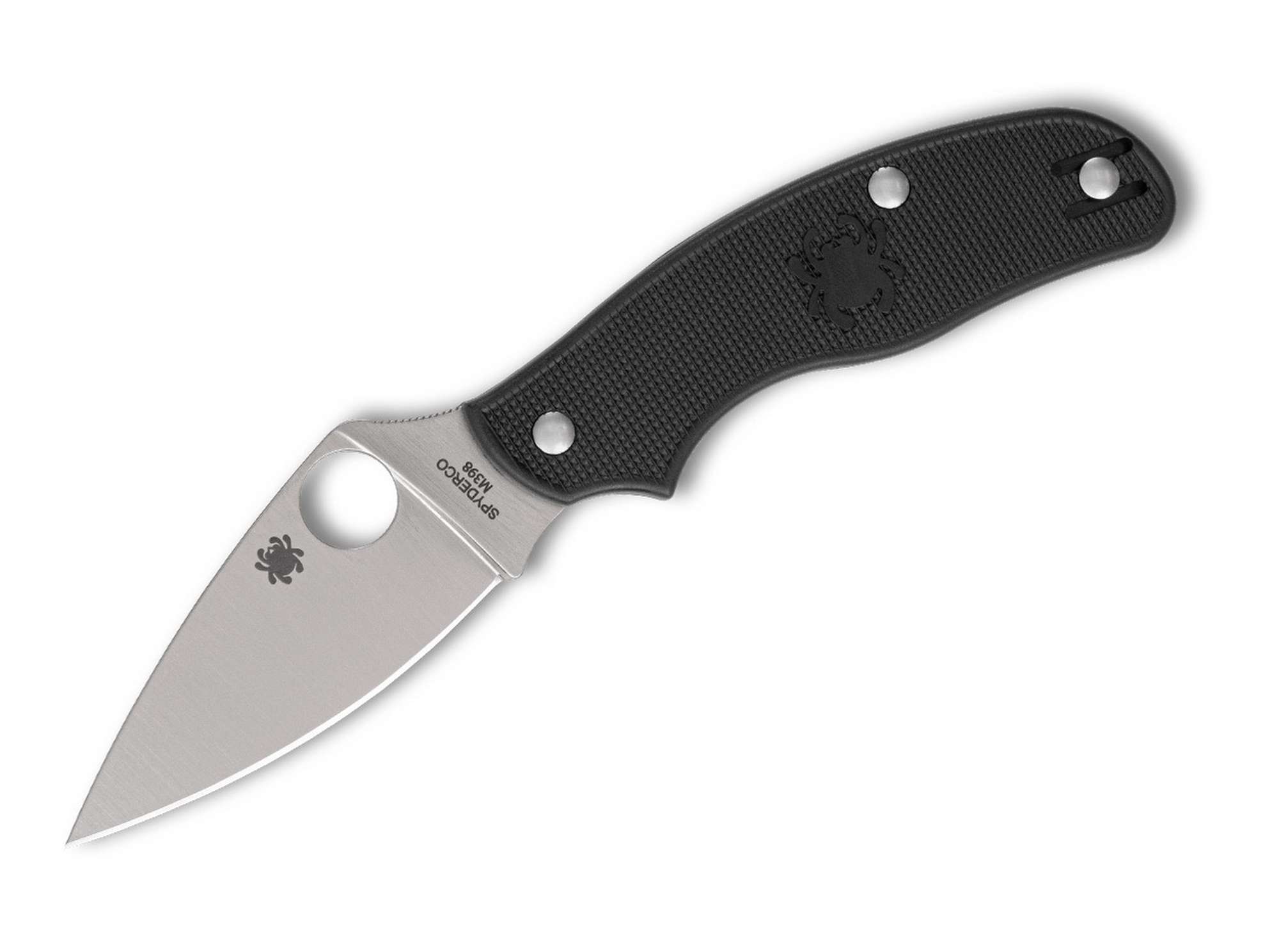
Imagine this: American ingenuity meets Italian passion – and instead of a deep-dish pizza, you get the Spyderco Metropolitan. Designed in Colorado and crafted in Italy, this slipjoint is as smooth as an espresso in Rome and as reliable as a burger in Denver.
The Metropolitan is essentially the little brother of the legendary UK Penknife – or rather, the cousin who feels at home on both sides of the Atlantic. With an overall length of 16 cm, it sits perfectly between the UKPK and the Urban. For those familiar with the old SpyDK (now discontinued), the handle will feel familiar – just with an updated high-performance blade.
The blade is Böhler M390 – a high-end powdered steel so edge-retentive your cardboard boxes will already be nervous. Add the feather-light 54 g FRN handle, which is barely noticeable in your pocket, and the reversible wire clip for carry convenience – left or right side. And, of course, the iconic Round Hole: slip in a finger, a gentle push, and the blade is deployed.
In short, the Metropolitan Lightweight is Spyderco’s answer to whether a modern slipjoint can be practical, §42a-compliant, and stylish at the same time. The answer? Si!
Legal, corrosion-resistant and eye-catching – the UKPK Salt in MagnaCut
Question: what is bright yellow, extremely corrosion-resistant and a pretty sharp affair? Bingo! The UKPK Salt (C94PYL) with a blade made from CPM MagnaCut – Spyderco's first non-locking knife in the legendary Salt Series.
Fully legal to carry – in the UK, Germany, Austria and Switzerland
It's no secret that knife laws in Europe are significantly stricter than in the USA. As one of the first major manufacturers to address this, Spyderco created the UKPK (UK Penknife) – a true European classic that even meets the very strict knife laws in Great Britain.
Two factors make the UKPK so special: while the blade opens one-handed via the Spyderhole, it does not lock in the open position. Instead, a strong backspring (slipjoint) holds the blade – the same principle as a classic Swiss Army knife. This makes the UKPK §42a-compliant in Germany and fully legal to carry in the UK under the Criminal Justice Act 1988.
Why MagnaCut? Our steel recommendation from the Knife Lounge
As an owner-run knife shop in Hamburg, we've handled the UKPK in every steel variant available. MagnaCut, developed by metallurgist Larrin Thomas, combines precisely calibrated amounts of chromium, vanadium and niobium – the result is a steel that is significantly more corrosion-resistant and better at holding an edge than most other stainless steels. In everyday carry terms: it stays sharp, even in wet or salty conditions.
Steel
Edge retention
Corrosion resistance
Sharpenability
CPM MagnaCut
★★★★★
★★★★★
★★★★☆
CPM SPY27
★★★★☆
★★★★☆
★★★★★
CTS BD1
★★★☆☆
★★★★☆
★★★★★
LC200-N
★★★☆☆
★★★★★
★★★★★
Small but mighty – highly functional EDC without a lock
At just 48 grams and with a 74mm blade, the UKPK barely registers in your pocket. The thin blade with its full flat grind is a genuine slicer in everyday use – Spyderco didn't build a gadget here, but a serious cutting tool. The characteristic slipjoint click at full open and half-close gives you clear feedback on the blade's position at all times. The choil at the base of the blade gives your index finger additional control.
The bright yellow FRN handles (Fiberglass Reinforced Nylon) are built without steel liners – lightweight yet stable. The yellow colour also has a practical advantage: the knife won't disappear at the bottom of a bag or backpack. The deep-carry wire clip is reversible and mountable on either side, making the UKPK fully suitable for left-handed users.
Frequently asked questions about the Spyderco UK Penknife C94PYL
Is the UKPK C94PYL legal to carry in the UK?
Yes, fully. Under the Criminal Justice Act 1988, a non-locking folding knife with a blade under 3 inches (76mm) is legal to carry in the UK. The UKPK has a 74mm blade and no locking mechanism – it was specifically designed to meet these requirements.
Is the UKPK legal to carry in Germany?
Yes, fully. Because the blade is held open by a backspring rather than a lock, the UKPK is §42a-compliant under German weapons law. It is one of the very few one-hand-opening knives that meets this requirement.
What is the difference between MagnaCut and LC200-N?
Both steels offer excellent corrosion resistance and are well suited to wet environments. MagnaCut provides significantly better edge retention and toughness, but requires a little more effort to sharpen. Choose MagnaCut for maximum cutting performance; choose LC200-N if you prefer quick touch-ups with a simple ceramic rod.
What is the Salt Series?
Spyderco's Salt Series is their line of maximum corrosion-resistance knives, originally developed for marine, diving and coastal use. The C94PYL is the first non-locking knife in the Salt Series.
Is the UKPK suitable for left-handed users?
Yes. The wire clip is reversible and can be mounted on either side. The Spyderhole works equally well with the left thumb.
How do I sharpen a MagnaCut blade?
MagnaCut runs at approximately 61–63 HRC. A basic honing steel won't be sufficient – we recommend a whetstone (400–1000 grit) or a quality ceramic rod with some patience. For day-to-day maintenance, stropping on leather will keep the edge going significantly longer between full sharpenings.
Where does the name "UK Penknife" come from?
The UKPK was originally developed for the British market, where one-hand-opening locking knives are prohibited in public. Spyderco created a fully legal everyday carry knife that still offers all modern EDC features – and it quickly became a favourite across Europe too.
Jens Anso - Monte Carlo Zirconium
Zirconium handle scales
Blade made of RWL 34 Handrubbed
Including certificate
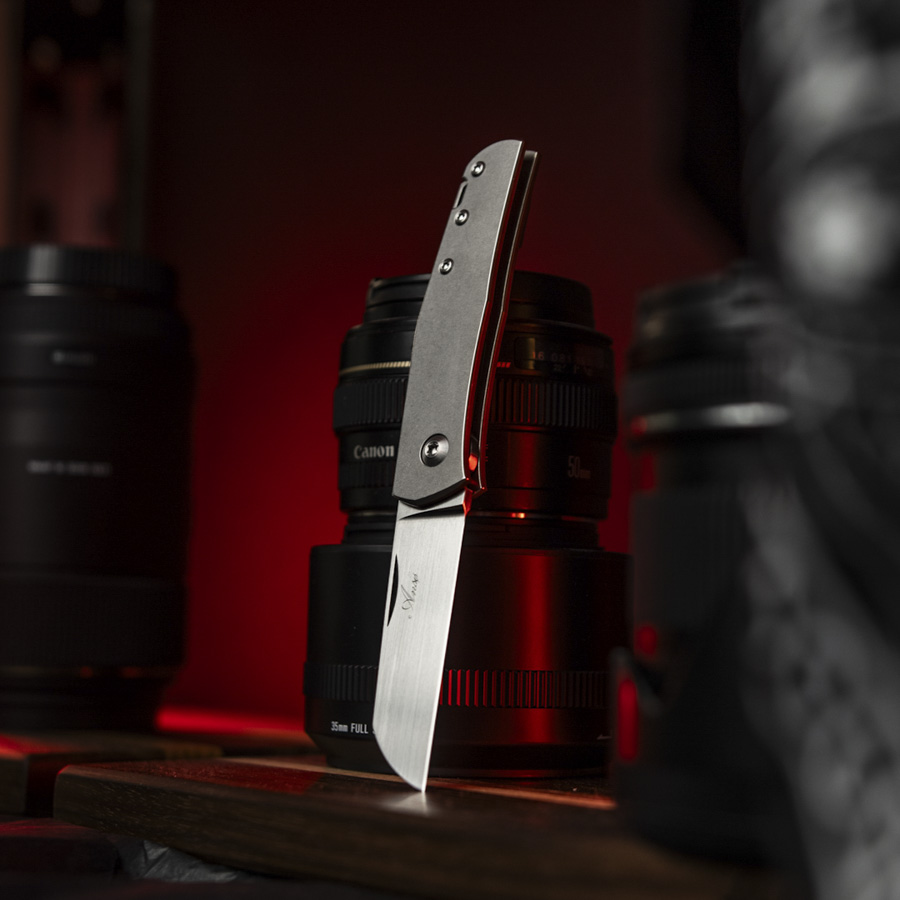
Cool GentlemanThere is hardly any other place in the world where elegance, glamour, high-tech as well as old and new come together in such a spectacular way as in Monte Carlo on the coast of the city-state of Monaco. The legendary Formula 1 race in the time-honored streets of the principality is considered to be one of the most difficult of all and always ensures high excitement in motor sports. But even if you are not a motorsport fan, you will like this little EDC companion.
The choice of name for this great Ansø knife could hardly be more appropriate.
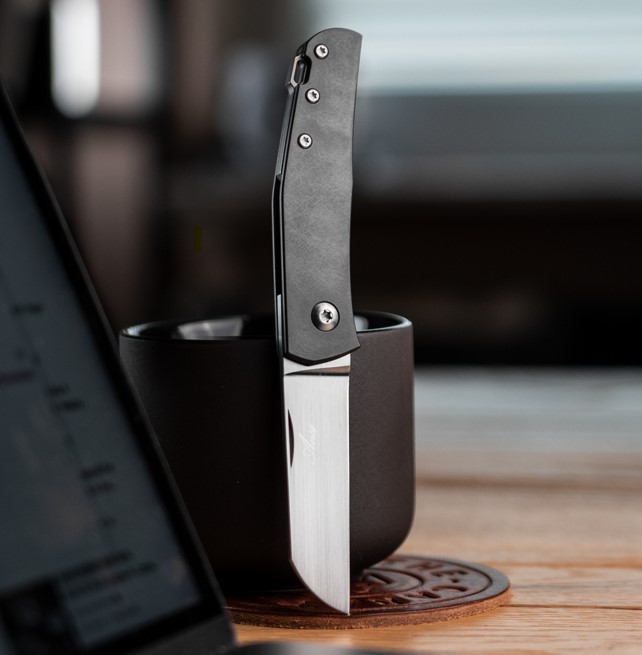
The incredibly clear line and the choice of materials that go hand in hand with it, make the Monte Carlo appear both discreet and noble and sporty and relaxed. The handle is an open construction with handle scales made of brushed zirconium, which is connected on the back by a colored anodized titanium backspacer (gray on this version). The open construction allows you to clean the knife very easily after use, for example if there is dirt on the inside.
For the blade, the veteran and excellent RWL-34 steel was used, which has proven itself over the years as an excellent blade steel. This alloy, invented by Damasteel in Sweden, is produced using a powder metallurgy process and is basically an update to the American and popular 154CM steel. By the way, the abbreviation RWL stands for Robert Waldorf Loveless, one of the most important knifemakers of all time, who loved to use this steel for his blades. RWL-34 has a high edge retention and a very good corrosion resistance so that you can work with food completely harmless.
The real highlight of the Monte Carlo, however, besides the great looks, is the closure technology. Strictly speaking, you don't have a real lock here, but a so-called friction folder. This means that the blade is only held by two detent balls to the right and left of the blade root, which gives you a very smooth blade action and an incredibly defined engagement of the blade.
But what does V2 actually mean?Jens Anso has once again thought about how he can improve the Monte Carlo. The result is new titanium screws, a uniform width of the handle scales, and even better and more precise machining processes.
Colors:Antracite Zirconium
The zirconium handle scales offer an exciting surface that also feels great thanks to the brushed finish. The backspacer as well as the clip are made of gray titanium.
Version:
Grey titanium, pocket clip and backspacer blue
Cool GentlemanThere is hardly any other place in the world where elegance, glamour, high-tech as well as old and new come together in such a spectacular way as in Monte Carlo on the coast of the city-state of Monaco. The legendary Formula 1 race in the time-honored streets of the principality is considered to be one of the most difficult of all and always ensures high excitement in motor sports. But even if you are not a motorsport fan, you will like this little EDC companion.
The choice of name for this great Ansø knife could hardly be more appropriate.
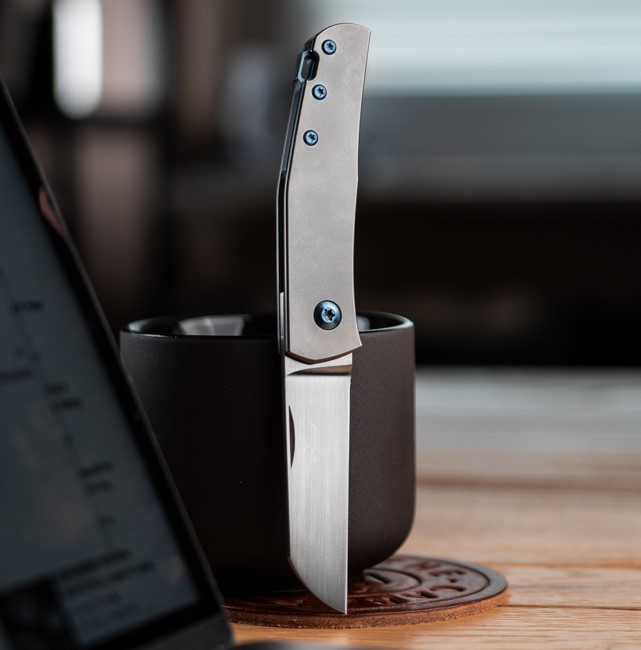
The incredibly clear line and the choice of materials that go hand in hand with it, make the Monte Carlo appear both discreet and noble and sporty and relaxed. The handle is an open titanium construction, which is connected on the back by a colored anodized titanium backspacer. The open design makes it very easy to clean the knife after use, for example if dirt is on the inside.
For the blade, the veteran and excellent RWL-34 steel was used, which has proven to be an excellent blade steel over the years. This alloy, invented by Damasteel in Sweden, is produced using a powder metallurgy process and is basically an update to the American and popular 154CM steel. By the way, the abbreviation RWL stands for Robert Waldorf Loveless, one of the most important knifemakers of all time, who loved to use this steel for his blades. RWL-34 has a high edge retention and a very good corrosion resistance so that you can work with food completely harmless.
The real highlight of the Monte Carlo, however, besides the great looks, is the closure technology. Strictly speaking, you don't have a real lock here, but a so-called friction folder. This means that the blade is only held by two detent balls to the right and left of the blade root, which gives you a very smooth blade action and an incredibly defined engagement of the blade.
But what does V2 actually mean?Jens Anso has once again thought about how he can improve the Monte Carlo. The result is new titanium screws, a uniform width of the handle scales, and even better and more precise machining processes.
version 2.0
Titanium handle scales
Blade made of RWL 34 Handrubbed
Including certificate
Cool GentlemanThere is hardly any other place in the world where elegance, glamour, high-tech as well as old and new come together in such a spectacular way as in Monte Carlo on the coast of the city-state of Monaco. The legendary Formula 1 race in the time-honored streets of the principality is considered to be one of the most difficult of all and always ensures high excitement in motor sports. But even if you are not a motorsport fan, you will like this little EDC companion.
The choice of name for this great Ansø knife could hardly be more appropriate.
The incredibly clear line and the choice of materials that go hand in hand with it, make the Monte Carlo appear both discreet and noble and sporty and relaxed. The handle is an open titanium construction, which is connected on the back by a colored anodized titanium backspacer (gray in gray on this version). The open construction allows you to clean the knife very easily after use if, for example, dirt sits on the inside.
For the blade, the veteran and excellent RWL-34 steel was used, which has proven to be an excellent blade steel over the years. This alloy, invented by Damasteel in Sweden, is produced using a powder metallurgy process and is basically an update to the American and popular 154CM steel. By the way, the abbreviation RWL stands for Robert Waldorf Loveless, one of the most important knifemakers of all time, who loved to use this steel for his blades. RWL-34 has a high edge retention and a very good corrosion resistance so that you can work with food completely harmless.
The real highlight of the Monte Carlo, however, besides the great looks, is the closure technology. Strictly speaking, you don't have a real lock here, but a so-called friction folder. This means that the blade is only held by two detent balls to the right and left of the blade root, which gives you a very smooth blade action and an incredibly defined engagement of the blade.
But what does V2 actually mean?Jens Anso has once again thought about how he can improve the Monte Carlo. The result is new titanium screws, a uniform width of the handle scales, and even better and more precise machining processes.
Lead standard / pen length:
Parker = 12,7 cm
|
Lock:
Single Lock
Nottingham Tactical TiButton Titanium – Killer Beez
The Nottingham Tactical TiButton Titanium Killer Beez is a precisely machined titanium pen with a textured surface and a fully mechanical push-button mechanism. Made from solid titanium and produced entirely in the USA.
Nottingham Tactical is a small manufacturer with only a few employees. Pens are made in small batches, with a high level of manual work and a clear focus on mechanics and build quality rather than mass production. Each pen is individually assembled and inspected.
The Killer Beez pattern consists of evenly machined hexagonal recesses. The structure improves grip in the hand and helps prevent the pen from rolling on flat surfaces. The pattern is functional by design and deliberately restrained.
At the core of the pen is the TiButton mechanism – a purely mechanical construction with no side-to-side play or rattle. The click is defined and built for long-term use. Available in Single Lock or Double Lock configurations.
Single Lock: direct actuation point
Double Lock: additional lock to prevent accidental deployment
Compatible with Parker-style, Pilot G2, and Pilot G2 Mini refills.
Developed with a focus on mechanics, durability, and a distinctive appearance – functional for everyday carry and deliberately not a mass-market pen.
Made in USA.
Nottingham Tactical Leadslinger Pencil
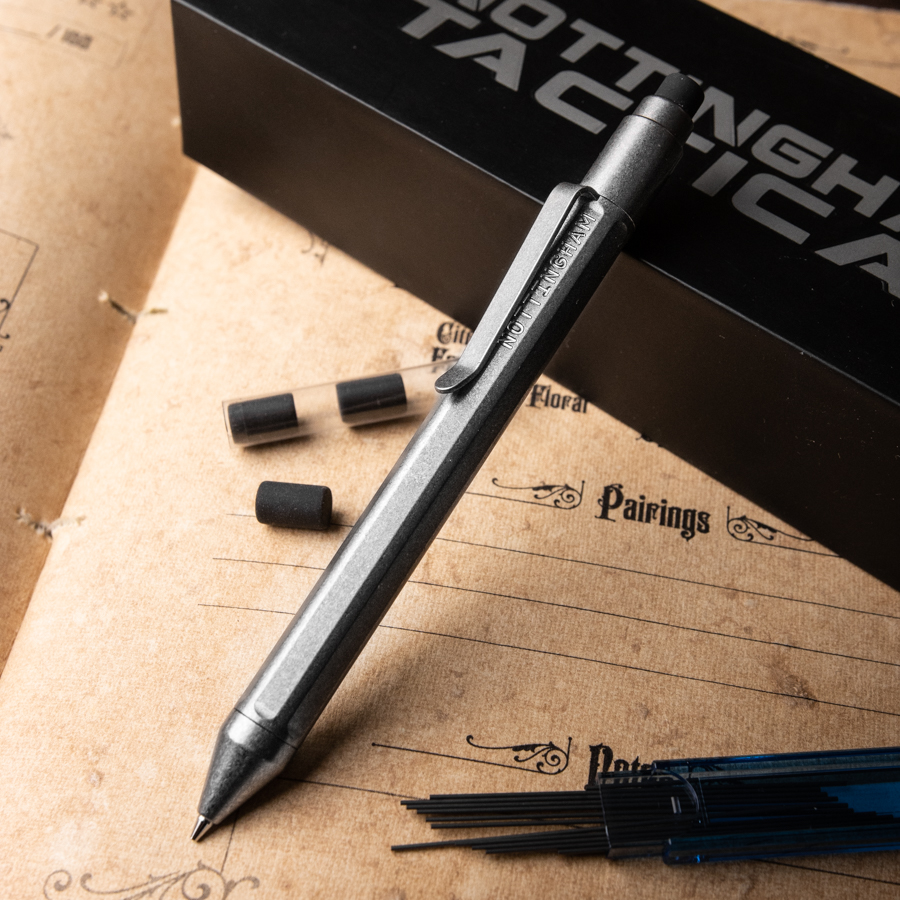
Mechanical pencil Deluxe! made of titanium
small series production by Lee Nottingham
lead size: 0,5 mm or 0,7 mm
Made in the USA
Dimensions and accessories:Diameter: approx. 11 mm (7.16")Length: approx. 12.4 cm (4.875 ")Weight: 32 gramsAccessories: 3 extra erasers, 1 pack of spare HB leads
Nottingham Tactical Clip Plain Face Tumbled
Titanium clip milled from solid titanium
Premium clip for your Nottingham Tactical Pen
Comes with an adapter to replace the standard clip
Titanium screws
Included in delivery:1 clip, 1 clip adapter and 2 titanium screws
Chris Reeve Umnumzaan Tanto - The Boss
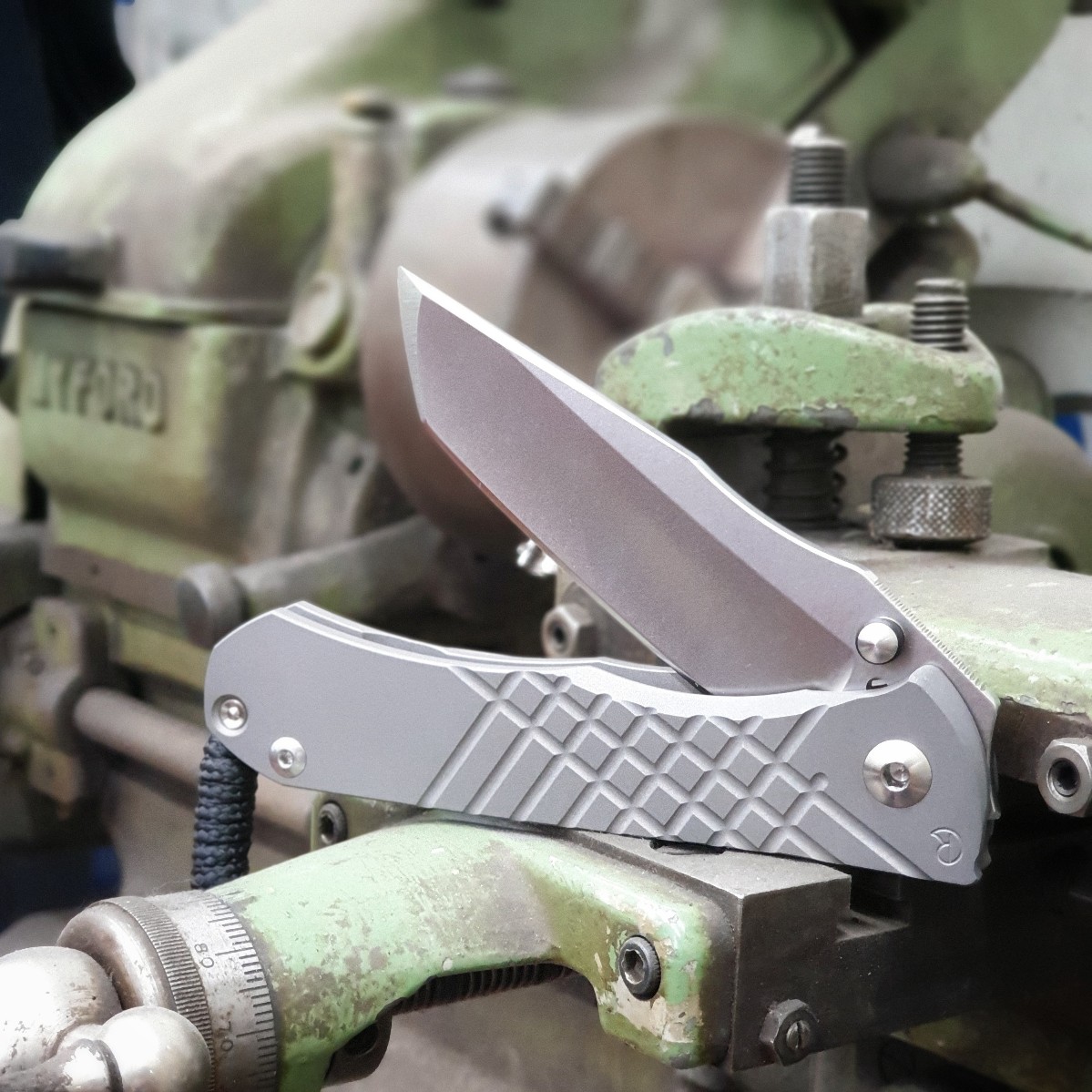
This is how the word "Umnumzaan" from the Zulu language of South Africa could be translated into German.And Reeve do not promise too much: the Umnumzaan is really the boss of the Reeve folding knives.Unlike the Sebenza 21 or the Inkosi, the blasted titanium handle has been given a milled pattern, which makes for a cool look on the one hand and more grip on the other.The shape has also been made more ergonomic to achieve an even better hand position. When closing the Umnumzaans Chris Reeve Knives have come up with something special: the Detentball, which was made of an extremely hard ceramic, also serves as a contact point to the blade root when the knife is open.This ensures that the softer titanium does not wear out over the years when it comes into contact with the hardened steel. At the same time, an overtravel stop has been incorporated, which ensures that the locking mechanism is not accidentally overstretched when unlocked.
The hollow ground blade made of CPM S35VN steel, co-developed by Chris Reeve, is as stable as it is cutting-friendly and, thanks to the recesses placed on the back of the blade, proves to be very easy to grip.The thumb can therefore be comfortably placed on the blade to exert more pressure on the cut material.The thumb pins on both sides not only serve as an opening aid, but also ensure a defined blade stop when open, while the rubber coating of the pins protects the titanium from scratches.As with all other Reeve folding knives, the Umnumzaan has the typical defined blade action where you feel like the blade is running on glass. When the knife is closed, the blade root acts as a glass breaker, which further emphasizes the tactical character of the Umnumzaan.
Reeve have actually created a knife with the Umnumzaan, which on the one hand is incredibly sturdily constructed, but on the other hand still displays an excellent cutting performance. So if you are looking for a really massive folding knife, the Umnumzaan might be interesting for you.
TantoHardly any Tanto blade is as universally applicable as Chris Reeve's interpretation. Thanks to its slightly bulbous shape, this blade combined the cutting ability of a droppoint blade with the sturdiness (especially in the tip) of a tanto knife.
Accessories:
Chris Reeve Umnumzaan O-Rings
Chris Reeve Umnumzaan Backspacer Pin and Screw Kit
Chris Reeve Lanyard classic for Sebenza and Umnumzaan
Chris Reeve Backspacer
Chris Reeve pocket clip
Chris Reeve Grease
Chris Reeve Body Screw
Lenyard Pin
The iconic classic in a glass-blasted finish.
Available in Large or SmallReeve Integral Lock with ceramic ball on lockbarBlade Steel: Magnacut
Clip Design: Off-set (on the 31, the clip now sits diagonally rather than straight)
When in June 2019 the end of the Sebenza 21 was proclaimed and with the Sebenza 31 the successor was presented, this message went like a drumbeat through the knife scene. Finally, new introductions of the manufacturer from Idaho are already very rare. If it is then still about the heritage of one of the most famous and best pocket knives of all time, such a thing does not remain without appropriate reaction. Fortunately, Chris Reeve Knives have improved their recipe for success all in all only minimally but in crucial places, so that one can justifiably continue to speak of a Sebenza in the new 31 model..
First, it is noticeable that the hole on the presentation side of the knife is now omitted - something that many Reeve fans have long wished for. The slightly altered angle of the pocket clip, which now no longer presses on the lockbar, is also quickly noticeable to the trained eye.
Less obvious, however, is the revised lock of the Sebenza 31. Just as with the Umnumzaan or the Inkosi, a ceramic ball embedded in the lockbar now presses against the blade root. The hardness of this ball is in a range that can hardly be measured, preventing long-term wear at the contact point of the lockbar..
To improve the hand position of the Sebenza once again a little, the recessed grip on the front was ground a little differently. All in all, we can say: yes, the new model rightly bears the venerable name Sebenza and can effortlessly tie in with the popular 21 series..
Small or Large?
Just like its predecessor, both sizes are still available.
While the large Sebenza 31 is a truly full-blown work knife, the Small Sebenza remains the king of EDC pocket knives - the hand placement continues to be great on the successor model. All of the features mentioned above can also be found in this smaller version of the Sebenza 31 - just in a slightly more compact and pocket-friendly form.
Glassblast vs. SandblastWondering what the difference is between glass-blasted and sandblasted? The glass-blasted finish uses crushed glass, resulting in a finer, tighter grit that is extremely scratch-resistant and smooth, but still retains its grip. Sandblasted, on the other hand, uses sand to create an extra grippy surface that ages with character.
The Boss – Designed Specifically for Left-Handed Users
"Umnumzaan" means "The Boss" in Zulu—and this knife lives up to its name. The Chris Reeve Umnumzaan is the most robust and technically advanced folding knife produced by Chris Reeve Knives. This version has been specifically built for left-handed users: the frame lock, thumb stud, and pocket clip are all configured exclusively for left-hand operation.
As an owner-operated knife store in Hamburg, we are one of the few German dealers offering the left-handed version of the Umnumzaan. If you're looking for a CRK and carry left-handed, there are few alternatives—and in our opinion, none better.
Engineered for Left-Handed Users – No Compromises
The Umnumzaan is available in a dedicated left-handed configuration that goes far beyond simply relocating the pocket clip. The Reeve Integral Lock—a frame lock positioned on the left side—has been designed from the ground up for left-handed operation. The dual thumb studs and pocket clip are also positioned accordingly. If you're left-handed and searching for a premium EDC knife, this is one of the very few truly serious options on the market.
CPM MagnaCut – 63–64 HRC, the Best Steel CRK Has Ever Used
Chris Reeve has transitioned the Umnumzaan to CPM MagnaCut—and this was a technical decision, not a marketing one. Developed by metallurgist Larrin Thomas, MagnaCut combines outstanding edge retention, toughness, and corrosion resistance in a single steel. Hardened to 63–64 HRC, the blade stays sharp for an exceptionally long time while remaining tough enough for demanding everyday tasks. Despite its substantial 3.6 mm blade stock, the hollow grind makes it a highly precise cutting tool.
The Reeve Integral Lock – A Frame Lock on Another Level
Chris Reeve invented the frame lock—and pushed the concept to its limits with the Umnumzaan. The ceramic detent ball also serves as the blade stop interface when the knife is open. This prevents the softer titanium lock face from wearing against the hardened steel blade tang over years of use. An overtravel stop prevents accidental overextension of the lock bar during disengagement. Phosphor bronze washers at the pivot reduce friction and help retain the fluorinated grease for longer periods. The result is the signature CRK action that feels as though the blade is running on glass.
Two Blade Shapes – One Decision
Drop Point (UMN-1001) – the more versatile choice. The sweeping blade profile, harpoon-style tip, and jimping recesses along the spine create a distinctive appearance while performing exceptionally well across a wide range of tasks. The finely tapered hollow grind delivers excellent cutting performance.
Tanto (UMN-1002) – the tougher choice. Chris Reeve's interpretation of the Tanto is unique: slightly curved and combining the cutting ability of a drop point blade with the reinforced tip strength of a traditional Tanto design.
Titanium, Glass Breaker, and 142 Grams
The sandblasted 6Al4V titanium handle with its machined crosshatch pattern provides a secure grip and gives the Umnumzaan a distinct appearance compared to the Sebenza and Inkosi. At 142 grams and an overall length of 21.4 cm, the Umnumzaan is not a discreet everyday carry knife—it is a statement piece. The blade tang functions as a glass breaker when the knife is closed.
Included in the package: 5/64" hex wrench, Chris Reeve Grease, microfiber cloth with CRK logo, and certificate of authenticity.
Frequently Asked Questions About the Chris Reeve Umnumzaan Left-Handed
What is the difference between the left-handed and right-handed Umnumzaan?
This is not simply a pocket clip conversion. On the left-handed model, the Reeve Integral Lock is positioned on the left side of the handle—the knife has been designed from the ground up for left-handed users. Right-handed users should choose the UMN-1000.
Is the Umnumzaan compliant with German §42a regulations?
No. The Umnumzaan features a frame lock, meaning the blade locks securely in place. Under German law (§42a WaffG), it is considered a one-handed locking knife and may only be carried in public with a legitimate reason.
What is the difference between the Umnumzaan and the Sebenza?
The Sebenza is CRK's classic and more refined folding knife. The Umnumzaan is larger, tougher, and more tactical in design, featuring a larger pivot, a more robust handle, and an integrated glass breaker. If you want a CRK as a hard-use working knife, choose the Umnumzaan. If you're looking for an elegant EDC, choose the Sebenza.
How do I maintain a Chris Reeve knife?
CRK recommends using the included fluorinated grease on the pivot. For normal everyday use, disassembling the knife once a year, cleaning it, and reapplying grease is sufficient. Keep the blade dry with a soft cloth—MagnaCut is highly corrosion-resistant, but it is not a license for neglect.
Gentleman/Woman version of the popular Cicada's Wing
Now featuring handle scales made from premium woods
Sheepfoot blade made from 10Cr15MoV or Damascus steel
Handle scales available in olive wood or desert ironwood
Reversible deep-carry clip
Moin. It always starts innocently. One knife, one pen. Then one knife turns into two, because you could not decide that morning, and eventually the multitool is lying next to them giving you a look. The Hamburger Pouch swallowed all of it without complaining. Right up until it could not any more.
Which is why the Big Burger Pouch exists.
Seven centimetres that change everything
We developed the larger version of our Hamburger Pouch together with Böker. Outer dimensions are 20,5 × 13,5 × 4,5 cm, which means seven and a half centimetres more length and another two and a half across. Does not sound like much. In practice it is the gap between “just about fits” and “there is room for one more”. It is also half a centimetre slimmer than its little sister, so it takes up more width in your bag without adding bulk.
The body is Cordura 500D, the fabric that has been doing the rough work on packs and gear for decades. It resists abrasion, holds its shape, and still looks like something after two years of being thrown around in a rucksack.
Inside
Flexible retaining loops hold your blades individually. Between the layers sits a removable protective flap that stops your titanium framelock from rubbing itself against whatever is lying beside it. Anyone who has ever found a scratch on a polished handle scale understands why that flap is in there.
There is plenty of loop panel inside and out. Once you start collecting patches, running out of surface area becomes a real issue.
Böker Barlow BFF Titanium Damascus – limited to 88 pieces
The Barlow pattern is roughly as old as the idea of folding a knife in the first
place. Farmer's knife, working man's knife: for centuries it was simply what you had
on you, because you needed it. Lucas Burnley turned it into a fixed blade that looks
like it has always existed in that form. And now there's a version with a Damascus
blade.
Damascus and titanium
The full-tang construction runs all the way through to the butt of the handle, with
titanium scales over it, kept smooth and slim. The Damascus pattern comes out
differently on every piece. No two are identical, which with a worldwide run of 88 is
a fairly manageable problem.
Blade length7 cm (2.76")
Blade thickness2.5 mm
Overall length15.3 cm (6.02")
Weight71 g
Blade materialDamascus
HandleTitanium, full tang
DesignerLucas Burnley
IncludedLeather sheath
Limitation88 pieces worldwide
In hand
In hand the Barlow BFF feels surprisingly manageable and somehow just practical. No
tactical posturing, no
Lucas Burnley design Golden coated Magnacut handel with TruStone ScalesDropPoint blade made from MagnaCut with golden coating Includes leather sheathHandmade in Solingen
Lucas Burnley design Black coated Magnacut handel with TruStone ScalesDropPoint blade made from MagnaCut with black coating Includes leather sheathHandmade in Solingen