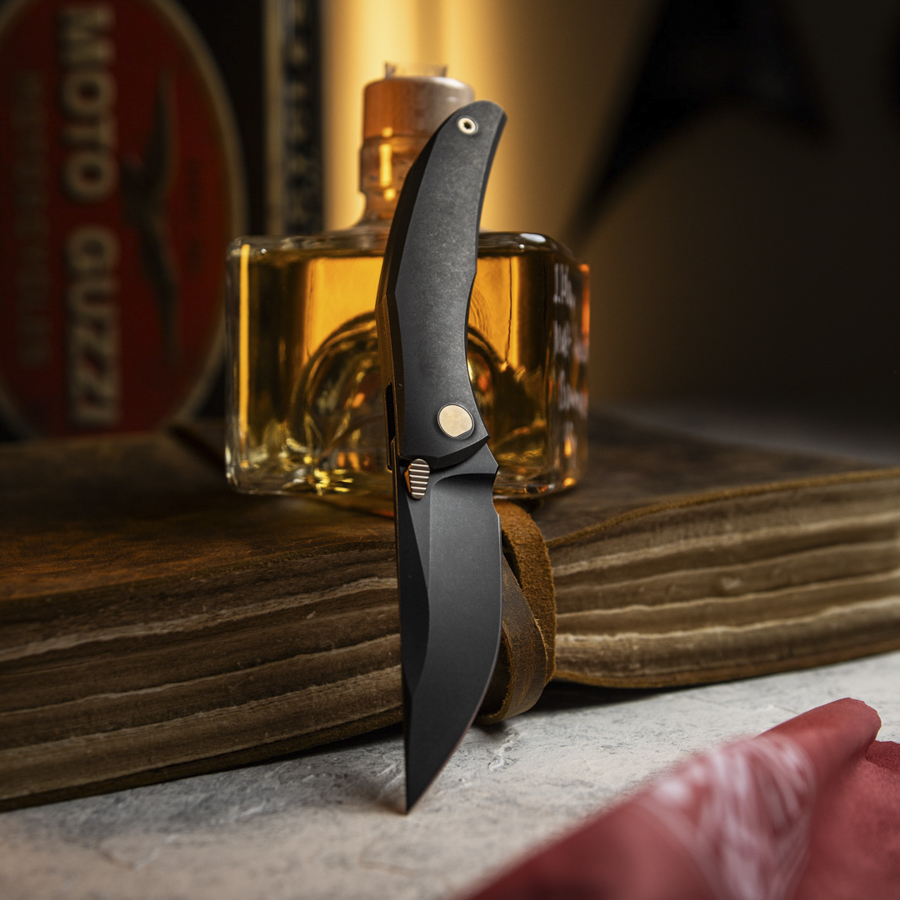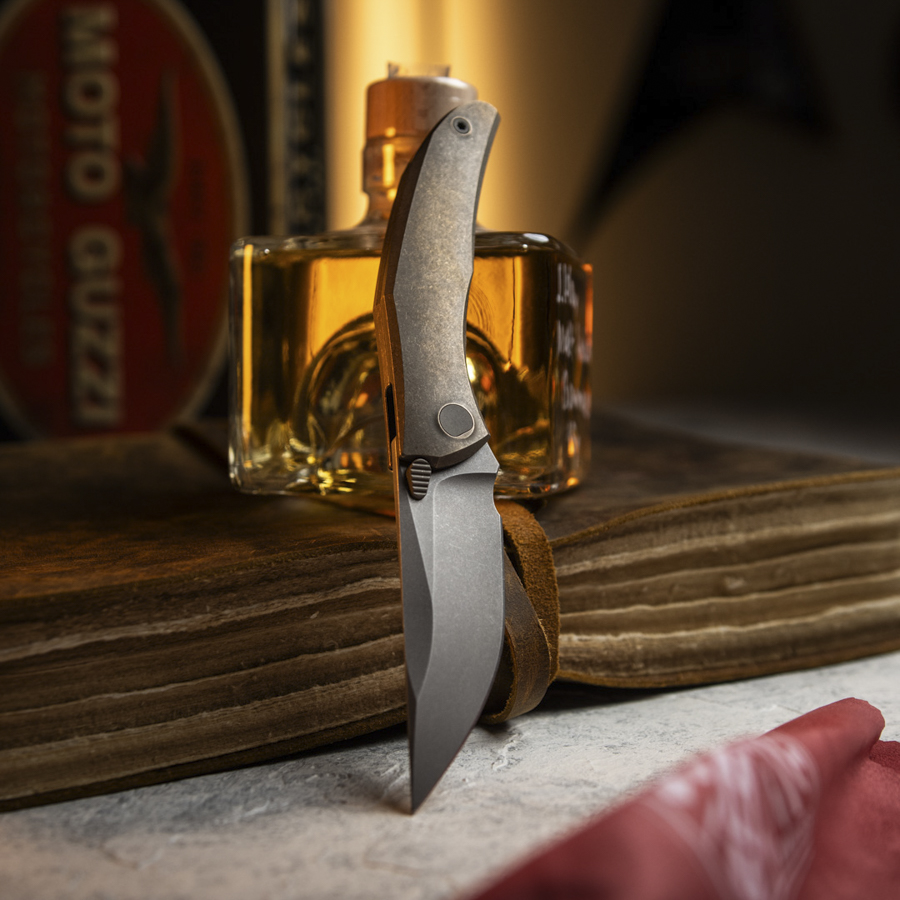


in cooperation with WE Knife Toni N. Tietzel design CPM 20CV blade with hand-satin or stonewashed finish 4 carrying options, switchable with the included Hardware Kit: Two-handed – without lock Two-handed – with lock One-handed – without lock One-handed – with lock (ships in this configuration) Imagine packing your bag in the morning without having to wonder whether the knife is even allowed where you're headed. That's exactly the question Toni Tietzel — the mind behind TNT Knives — spent years chewing on. The answer is called Slip Bang, and it comes exclusively from your Knife Lounge in Hamburg. The trick: instead of picking the knife that happens to fit the law, you build the one knife to fit. With two Torx sizes you turn the Slip Bang in seconds from a two-handed slipjoint without any lock all the way up to a full one-handed locking folder. In between sit the stages with thumb stud or slider — you swap a few inlays and bits of hardware, tighten the screws, done. No special tools, no fuss. The Hardware Kit you need for that comes included with the Slip Bang. Good to know: the Slip Bang ships with the thumb studs and slider already installed, meaning it opens one-handed and locks. If you want the free, two-handed slipjoint configuration without a lock instead, just remove the thumb studs and slider. What stays constant is the part that matters most: the blade. A drop point in CPM-20CV, a steel that holds its edge for ages and doesn't fret about a bit of moisture. The grind is, as always, thin and built for cutting performance. The handle is grade-5 titanium, the stuff you'd otherwise find in aircraft parts. Locking is handled by the newly developed TNT-Lock, and the whole thing is assembled at We Knife, the parent of Civivi, who know how to put something like this together cleanly. And now the part that matters for us here in Germany. As a two-handed slipjoint without a lock, the Slip Bang doesn't fall under § 42a and is legal to carry — that's the configuration for everyday use over here. As shipped, thumb studs and slider are installed, so the knife opens one-handed and locks. Whether that unambiguously makes it an Einhandmesser under §42a isn't entirely clear — more on that below in the FAQ. On Kickstarter the Slip Bang was funded with over €54,000 — three and a half times its goal — so the scene has voted pretty clearly. The blade measures around 8.4 cm, and opened up it comes to just under 19.8 cm at just under 110 g. By default the Slip Bang comes with a stonewash finish; the satin version is limited to 150 pieces. Included in the Hardware Kit Thumbstud inlays (both sides) T6 screws for the inlays T6 screws for the thumbstuds Cover plate (for two-handed configuration) T10 slider screw T10 clip screw T10 pivot screw Pivot barrel + D-shape pivot Small V-spring for the slider Frequently asked questions about the TNT Knives Slip Bang Does it matter if you close the knife quickly, letting it slap shut? No. A stop pin prevents the blade from striking the backspring, even when closing it quickly. The stop pin is press-fitted into the blade and runs in a circular groove machined into the scales, giving a precise stop in both the open and closed positions. As far as we know, this is also a unique feature for a slipjoint, though we can't say that with absolute certainty. Is the Slip Bang an Einhandmesser under §42a as shipped? As shipped, the thumb studs and slider are installed, so the knife opens one-handed and locks. Whether that unambiguously qualifies it as an Einhandmesser under §42a WaffG isn't entirely clear, since the lock on the Slip Bang is engaged separately and, as far as we know, there's no definitive ruling on this yet. If you want to be on the safe side, carry the knife in a closed container in public, or remove the thumb studs and slider for the unlocked, two-handed configuration. Do I need extra tools to reconfigure it? You need two Torx sizes: T6 for the inlays and thumbstud screws, T10 for the slider, clip, and pivot. Both are common sizes that most multitools with a bit set cover. The Hardware Kit you need is included with the Slip Bang. How do I care for the CPM-20CV blade? CPM-20CV is corrosion-resistant, but like any steel, not fully rust-proof. After contact with moisture or acid (for example when cutting fruit), just wipe the blade down and store it dry.