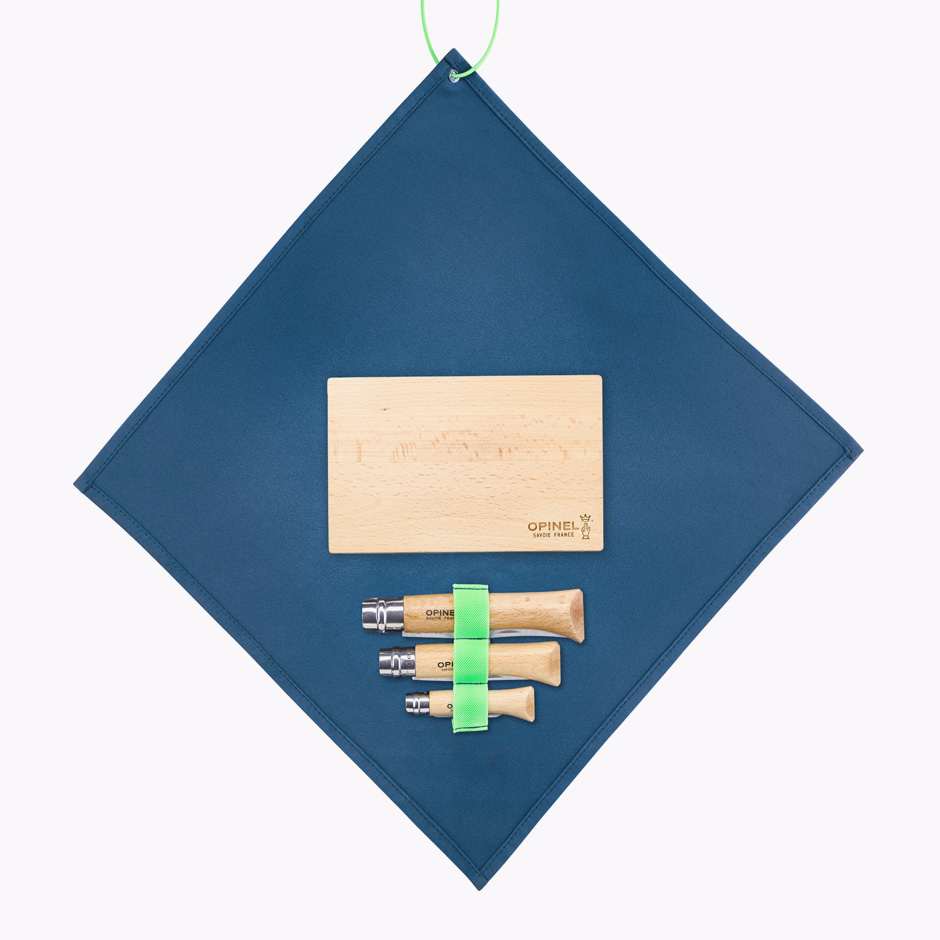

You're standing at check-in, suitcase on the scale, and somewhere in the back of your mind there's a quiet unease: Am I actually allowed to bring this? The pocket knife that's been your loyal companion for years. The Swiss Army knife from last birthday. The folding knife you just can't leave at home.
Welcome to the grey area of travelling with knives – and welcome to the Knife Lounge, where we don't feed you vague bureaucratic nonsense, but real answers.
Messer im Handgepäck: Verboten. Keine Ausnahmen, kein Verhandeln, kein "Aber es ist nur 7 cm".
Messer im aufgegebenen Koffer: Erlaubt – wenn sie ordentlich verpackt und nicht griffbereit sind.
Schweizer Taschenmesser, Klappmesser, Jagdmesser: Alle gehören in den Koffer, nicht ins Handgepäck.
Kochmesser: Dasselbe gilt. Auch das japanische Gyuto, das Santoku oder dein geliebtes Kochmesser-Set reisen ausschließlich im aufgegebenen Koffer – fest in der Messertasche oder einzeln in Schutzrollen verpackt, Klingen gesichert. Wer regelmäßig mit Kochmessern fliegt – z.B. für private Kochevents oder als Profikoch auf Reisen – muss es nicht aktiv deklarieren. Wichtig ist einzig: sicher verpackt, Klingen geschützt, im aufgegebenen Koffer.
So. Jetzt ins Detail.
Anyone who owns a quality knife doesn't just carry it anywhere – they carry it with intention. That's exactly why the question of how to travel with a beloved blade is no small thing. A Swiss Army knife that's served you faithfully for twenty years doesn't deserve to be confiscated at a security checkpoint in Frankfurt. And a custom folding knife even less so.
We at the Knife Lounge get that. Our community are people who know the value of their knife – and who want to know how to travel the world with it, without losing it or constantly drawing nervous glances from security staff.
The International Air Transport Association (IATA) sets the framework that most airlines follow. The most important points in brief:
Knives of any kind – whether pocket knives, folding knives, Swiss Army knives or multitools with a blade – are strictly prohibited in carry-on luggage. This applies worldwide, on every commercial flight, regardless of blade length or knife type.
Why? Because security authorities don't want to start weighing up every single blade individually. The rule is simple so it can be enforced consistently.
Can I take a knife in my carry-on luggage?
No. Knives – including pocket knives, folding knives and Swiss Army knives – are prohibited in carry-on luggage on flights worldwide. They must be transported in checked baggage without exception.
Things look better here. Knives may be taken in checked luggage if the following conditions are met:
For many of us, the Swiss Army knife is more than a tool – it's a piece of history, an heirloom, a reliable companion. And yes: it falls under the same rules.
Swiss Army knife in carry-on luggage: Generally prohibited – with one exception on paper.
A 2010 EU directive theoretically allows blades under 6 cm in carry-on luggage. Some airports like Zurich do actually apply this rule. In practice though, it's a different story: the final decision always lies with the security staff on the ground – and they usually crack down on knives in carry-on luggage, regardless of how short the blade is. Even Victorinox officially recommends always transporting pocket knives in checked luggage. If you want to play it safe, stick to that.
Swiss Army knife in checked luggage: Allowed.
Pack it well, put it in the middle of your suitcase, protect the blade. Done.
If you fly regularly and can't do without your Victorinox: pick up a cheap backup at your destination and leave it there. For your favourite piece, checking it in is absolutely worth the effort.
Aviation security regulations are relatively standardized internationally. But the moment you land, the laws of the country you’re in apply — and those can vary significantly.
Knives with a blade length over 7.62 cm (3 inches) are generally prohibited in public, with only a few exceptions. If you travel to London with a larger folding knife, it’s best to leave it at the hotel.
In the United States, knife laws are regulated on both federal and state levels. What’s perfectly legal in Texas may already be illegal in New York. The TSA allows knives in checked luggage without blade length restrictions — but local laws may still limit what you can legally carry or use once you arrive.
Japan has very strict knife laws. Folding knives with blades longer than 6 cm can already become problematic. When in doubt, leave the knife at home and research local regulations beforehand.
Germany follows its own weapons legislation. In public, only one-handed opening knives with a locking blade are generally prohibited. Legal are one-handed opening knives without a lock, as well as all two-handed opening knives — whether locking or non-locking — with a blade length under 12 cm. However, this applies only in most public areas. In designated weapon-free zones (for example certain city centers, train stations, or event locations), stricter rules may apply. While transporting a knife in your luggage during travel is usually not an issue, German law applies the moment you land and carry the knife in public.
Our recommendation: Before traveling abroad with your knife, take a few minutes to check the local laws. Five minutes of research can save you a lot of trouble.
A good knife deserves good protection. That’s not just important for air travel, but also for the long-term condition of the blade.
Original packaging: If you still have the original box — perfect. It’s usually well padded, protects the blade, and keeps the knife from moving around inside your luggage.
Leather slip or sheath: The classic solution for fixed blades and folding knives with a sheath. It protects the edge and helps prevent accidental opening. If you’re traveling with multiple knives, a high-quality pouch makes a lot of sense — like the Knife Lounge Hamburger Pouch, which offers space for several knives while keeping them safely separated from each other.
Tape over the blade: For non-locking folding knives, a strip of tape can add an extra layer of security. Not exactly high-tech, but it works.
Soft pouch or bubble wrap: Especially useful for transporting multiple knives or protecting your favorite piece. Extra padding helps avoid scratches and keeps everything together.
Never in an outer pocket: Always place your knife inside the main compartment of your suitcase — ideally in the center, surrounded by clothing for additional protection.
It happens to the best of us: your pocket knife is still in your jacket, the jacket goes into your carry-on, and suddenly the security scanner lights up.
So what happens next?
Our take: If it’s a good knife, it’s worth arriving at the airport 20 minutes earlier and checking your luggage properly. A knife that’s been with you for years is worth the extra effort.
At Knife Lounge, we believe that a good knife is not a disposable product. Once you’ve chosen a proper blade, you naturally want to have it with you — no matter where the journey takes you.
Before packing:
KNIFE LOUNGE
Checklist: Traveling with Knives
We carry knives you won’t find around every corner — built for an Every Day Carry that actually feels personal.
And if you’re unsure what you can bring on your next trip: just send us a message. We’re happy to help.
Legal notice: Laws and airline regulations can change. Always check the latest rules of your airline and the legal regulations of your destination before flying. This article provides a general overview but does not replace individual legal advice.